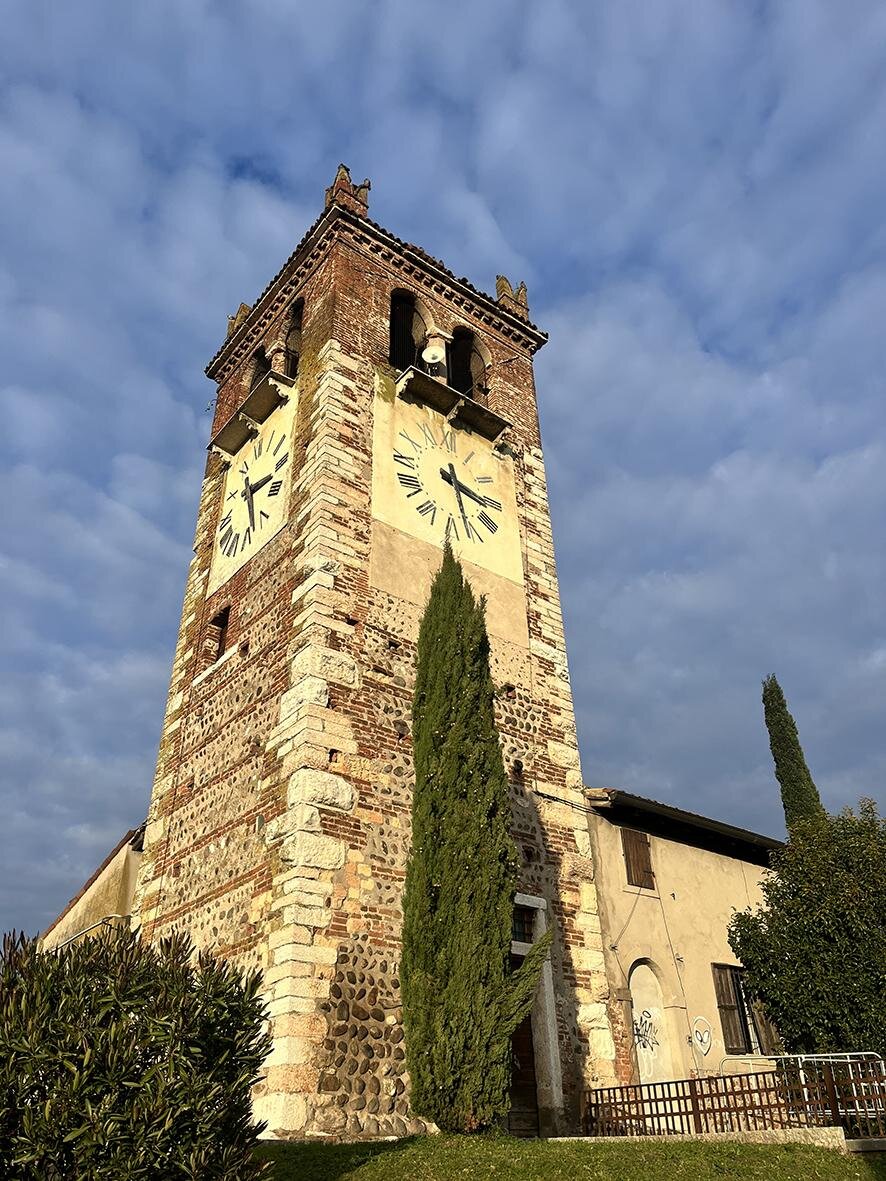
Torre Scaligera
The 14th-century Scaligera Tower rises on a hill 200 meters (above sea level), has a base of six meters, and reaches a height of 17 meters. Due to its dominant position, it functioned as a lookout point and was designated as a trigonometric point, meaning it was unmistakably visible from other locations. The main requirement: to be a structure that ensures its preservation over time.
The tower has four two-light openings supported by brick columns and Ghibelline merlons at the corners of the roof with tiles. Nine bells are located in the bell chamber, a complete concert, played by award-winning bell ringers who perform concerts using the Veronese method. Clocks are positioned on the south and west sides. The Scaligera Tower still retains a lion of Saint Mark, symbol of the Republic of Venice that ruled over these lands from 1405 to 1796. It is said to have been part of a fortification with four towers; indeed, during the earthworks on the west side of the tower, an ancient wall connecting the nearby building, known as the "Castle," now Villa Manzati, was discovered. The massive complex is still equipped on the east and west sides with two crenellated towers, and being situated in a strategic position on the last morainic hill that slopes down towards the Po Valley, it once served, like the tower, as an important lookout point. Inside, some rooms are adorned with 18th-century frescoes depicting pastoral scenes.
Next to the tower, there is still a structure owned by the Municipality of Sona, which was once the residence of the family of Giuseppe Tacconi, the sacristan of the parish and bell ringer. Through the bells, he announced liturgical celebrations and marked the hours, regulating the life of the village, now made possible by mechanization.