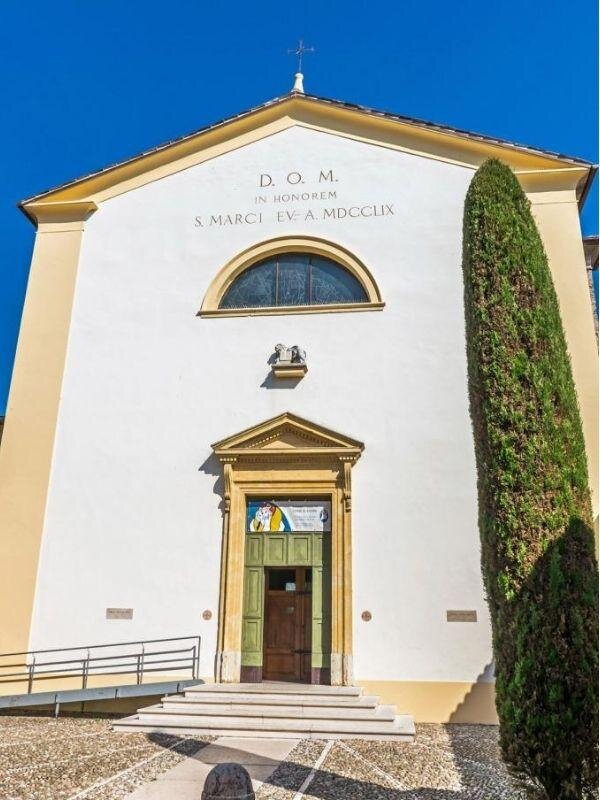
Chiesa di San Marco Evangelista
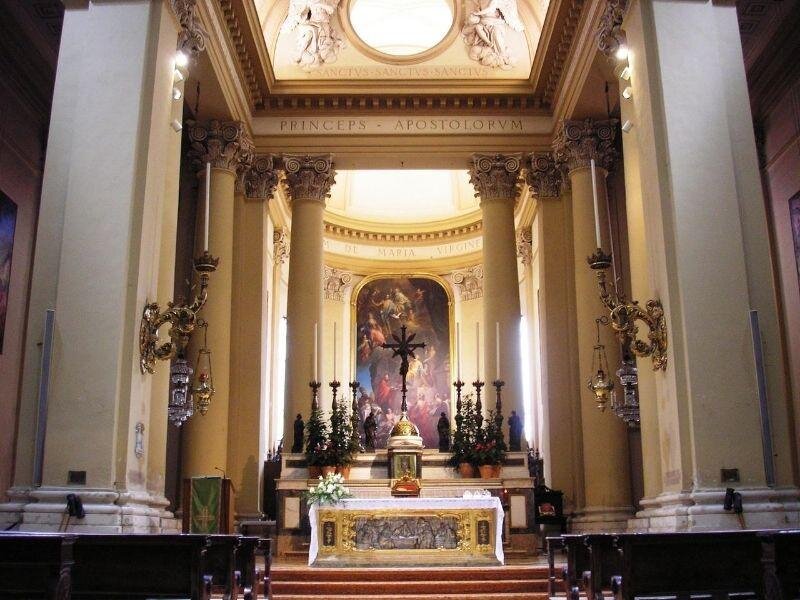
Built on the remains of a Romanesque church from the 11th century, dedicated to Santa Maria and an ancient Templar preceptory, it preserves a neoclassical style and a single-nave layout with a lowered vault.
The ancient cemetery behind the Church, restored in the 1920s by the diligent and passionate Don L. Dall’Agnola, houses the oldest and most significant tombstones of local history and above all allows visitors to admire the triconical apse of the ancient Romanesque church with a Cluniac plan, the only surviving part of the ancient cenobium.
In the nearby Scaliger tower, a testimony alongside the crenellated door of the ancient fortified Castle of Borghetto, a bell chamber has been created: among the sacred bronzes, one bears the date 1381 in Gothic characters. Its toll, deep and evocative, can be heard only on twelve occasions of the liturgical year.
Near the San Marco bridge (or “wooden bridge”, as commonly called by the locals), embedded in the old medieval walls, is the statue of Saint John of Nepomuk, the Bohemian martyr. Once, the effigy was housed in a niche halfway across the bridge: the tradition, also found in countries of Central Europe, holds that the Saint protects from drowning those who fall into the waters of the river.