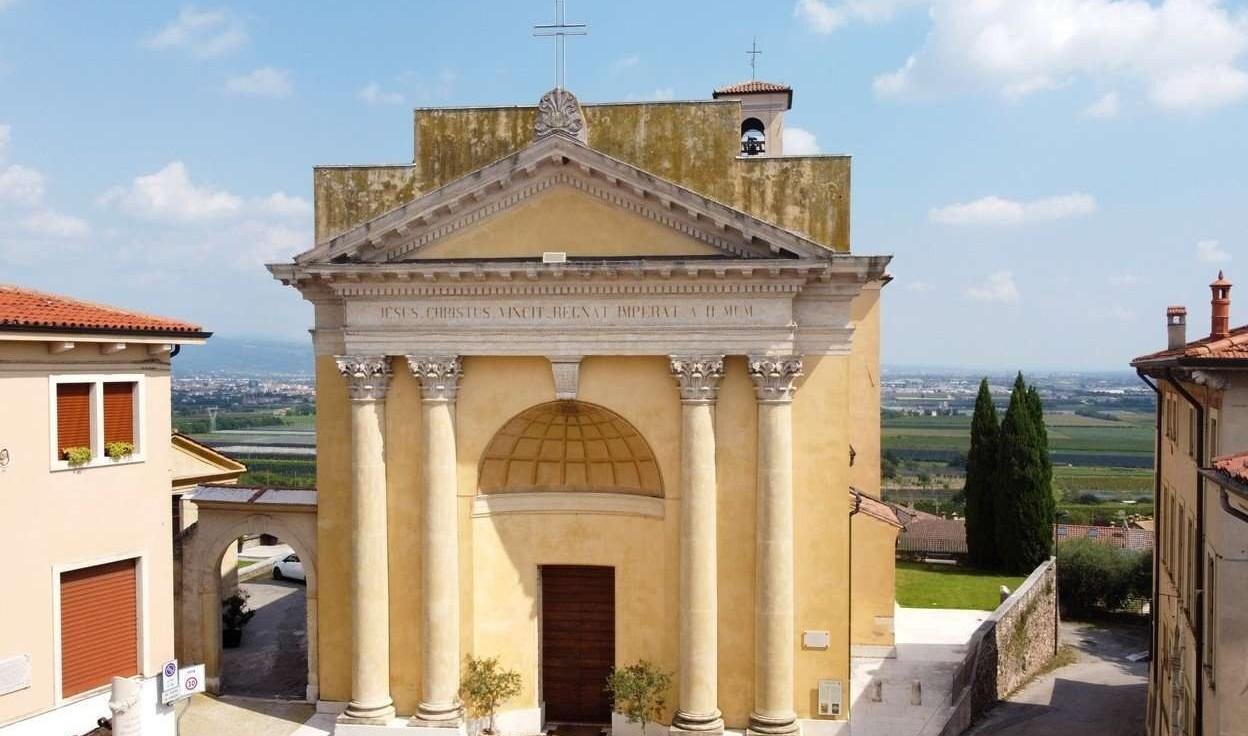
Chiesa Parrocchiale di San Giacomo e Santa Giustina
On the southern hill compared to the Pieve di Santa Giustina, there was once a chapel documented as early as 1436, around which the village was rebuilt following the destruction of the communal wars. Subject to the jurisdiction of the important parish, over time the chapel was increasingly frequented by local faithful who preferred it to the distant parish, which however maintained its rights and jurisdictions for centuries, where baptisms and important rites continued to be celebrated.
Over time, however, the Chapel of San Giacomo proved to be too small for the village: for this reason, it was expanded with the financial help of the then-autonomous Municipality of Palazzolo. Between 1813 and 1821, it was finally replaced by the current church, which took the name of the ancient chapel integrated with the name of the parish. Only the bell tower was not demolished, but elevated with a second bell chamber that houses a small bell from the parish.
The façade of the church, built in 1899, is neoclassical while the interiors are enhanced by precious altars in pink and yellow marble, and by paintings of considerable artistic value dating from the seventeenth to the nineteenth century attributed to names such as Balestra, Brusasorzi, Creara Farinati, Franceschini. Inside the church, there is a unique polychrome wooden crucifix dating back to the early 16th century, probably used in Easter liturgical ceremonies: the figure of Christ is articulated, and the arms are movable to allow their position along the body of the crucified Christ laid in the place of repose for adoration on Good Friday and Holy Saturday. The organ from 1835 was built by the famous Damiano Damiani.